


Bose Commercial Sound Systems: A Business Buyer’s Guide
October 10, 2026
A home cinema earns its value in the evenings you use it, not in promises about resale. If you’re asking “is a home cinema a good investment”, the answer depends less on screen size than on how often you’ll enjoy it, whether your room suits the setup and what ownership involves.
It’s easy to picture a projector transforming film nights, but a dedicated system isn’t the right fit for every household. A television setup may suit casual viewing, while a projector and well-matched audio can create a more immersive experience for regular films, sport and streaming. Your room, viewing habits and total equipment needs all shape the value.
This guide helps you weigh everyday enjoyment against practical trade-offs before choosing a system. You’ll compare projector and audio options, assess your room and consider power management. SoundXcel specialises in Epson home cinema projectors and premium Bose audio, so you can explore equipment options as you plan a home-viewing experience around your needs.
Key Takeaways
- Decide whether is a home cinema a good investment by weighing the enjoyment it brings your household, rather than assuming it will improve resale value.
- Estimate how often you’ll watch, who’ll join you and which content matters most before choosing a system.
- Assess the projector, viewing surface and audio together, then match those choices to your room and seating.
- Compare a dedicated setup with a television and basic audio by considering flexibility, setup requirements and how you watch day to day.
- Use your priorities to explore Epson home cinema projectors and Bose audio from SoundXcel.
Is a Home Cinema a Good Investment for Your Household?
A home cinema can be a good investment when it suits the way your household watches, the room can support the setup and the experience matters to you. The key question isn’t whether a large screen looks impressive on paper. Ask whether it would make regular film nights, sport, series or gaming more enjoyable at home.
That’s different from a financial return. A home cinema can create a more engaging shared experience, but enjoyment doesn’t guarantee savings or a higher resale value. Treat it as a lifestyle choice: weigh the equipment commitment against how much use and satisfaction you expect during the years you own it.
For a broad introduction to home cinema components and their development, see Home Cinema: An Overview. The video below also offers a perspective on practical considerations before building a home theatre setup.
What does “investment” mean when you build a home cinema?
Think about two parts: what you commit to the equipment upfront, and how consistently your household uses and enjoys it afterwards. A system that becomes the natural choice for weekend films or big matches may feel worthwhile in daily life. One used only for occasional special screenings may feel less valuable, even if its picture and sound impress you.
Estimate value across your expected years of use, not through a promised return. Consider whether the system supports the content you already enjoy and whether it fits ordinary evenings, not just planned viewing events. The answer to is a home cinema a good investment is personal because satisfaction depends on your habits, not a guaranteed financial outcome.
Who is most likely to get lasting value from a home cinema?
Households that regularly share films, series, live sport or gaming are more likely to make a dedicated viewing setup part of their routine. Different family members can also use it for different content, rather than relying on it for one occasional purpose.
By contrast, if most viewing happens on a phone or television in short bursts, a dedicated setup may see limited use. Some households prioritise a cinematic picture; others want a simple, flexible screen for everyday viewing. Space matters too. A room with comfortable viewing positions and practical equipment placement is more likely to make the setup easy to use.
A good home cinema investment is one your household uses often enough to make its viewing experience feel worthwhile, in a room that works for the way you live. Before deciding, picture a typical month: who would use it, what would you watch and how often would you choose it over your usual screen?
What Shapes the Real Value of a Home Cinema?
Home cinema value isn’t created by equipment alone. It comes from how often the system is used, who shares it, what they watch and how well the room supports the experience. A projector can deliver a large-scale picture, but the result also depends on the viewing surface, room conditions and audio working together.
Start with your household’s regular viewing. A system used for films, series, live sport or gaming can serve different interests across the week. If it’s mainly for occasional events, a flexible setup for everyday viewing may matter more than additional equipment. Think about the content you return to: dialogue-led series, fast-moving sport and atmospheric films place different demands on picture and sound.
How do projectors and sound contribute to the experience?
A projector displays an image on a screen or another suitable viewing surface, bringing a larger picture into the home. The surface and its position matter: the image needs to fit the room’s layout and be comfortable to watch from your usual seats. Epson home cinema projectors are an option to consider when a large-scale picture is a priority.
Audio has a distinct role. It gives dialogue, music and effects presence beyond the image, helping a film or match feel more engaging. The Bose Smart Ultra Soundbar supports Dolby Atmos and Bose TrueSpace. Those features apply to that soundbar, not to every Bose product. Choose audio around your preferred content and how you want sound to fill the viewing space.
Why should the room and viewing routine guide your budget?
Room conditions shape what equipment can do. Daylight and other ambient light affect how comfortable a projected picture is to watch; furniture, wall space and equipment placement influence where the image and sound can go. Seating matters too. If viewers sit at different angles or distances, consider whether everyone will have a comfortable view and hear the audio clearly.
Set priorities before comparing models or adding optional equipment. A household that watches mostly in the evening may need a different arrangement from one that uses the living room during bright afternoons. Note where a projector and viewing surface could go, whether people can watch comfortably, and whether audio equipment fits without obstructing everyday movement. These checks can narrow your choices before you commit.
When planning how projection and audio will work together, consider the room layout, the equipment connections and the content you watch. SoundXcel specialises in Epson projectors and Bose audio for customers across South Africa. Its home cinema equipment is a useful starting point as you shape your priorities.
Home cinema value grows from the fit between equipment, room and the way your household watches. Keep all three in view as you decide whether a home cinema is a good investment for your needs.
Home Cinema vs Simpler Viewing: Which Offers Better Value?
A dedicated projector-and-audio setup and a television with basic audio can both make sense. The better fit depends on the viewing experience you enjoy, your room and how much flexibility you need. A large, immersive presentation may be a priority for regular film nights, while a straightforward screen may suit casual viewing and a room used for many purposes.
| Factor | Projector and dedicated audio | Television and basic audio |
|---|---|---|
| Immersion | Can create a large-scale picture and a more enveloping shared viewing experience. | Offers familiar, direct viewing that can suit everyday programmes and shorter sessions. |
| Room flexibility | Needs suitable space for the projector, viewing surface, seating and audio. | Can fit more easily into a multi-use room, depending on the screen and furniture layout. |
| Setup complexity | Requires choices about placement, picture and sound working together. | Usually involves fewer elements to organise and position. |
| Likely usage | Well suited to households that plan regular shared film, sport or gaming sessions. | Practical for varied viewing habits or occasional use. |
This comparison isn’t a verdict. It helps identify which trade-offs matter in your home. A dedicated system may bring more ceremony to a planned film night, but it should still work with your room and normal routine. A television setup may be more satisfying if ease and adaptability matter more than screen scale.
When does a dedicated home cinema make more sense than a TV setup?
Consider a projector-based system if a large picture is central to your idea of a great viewing experience and you expect to use it often. Your room needs to accommodate the image and sound, with practical space for equipment and seating. Ambient light and layout also affect viewing comfort. A projector isn’t automatically the better option; the setup has to suit both the room and the people watching.
When is a simpler setup the more sensible choice?
Choose flexibility if viewing is occasional, space is limited or the room regularly changes function. A television paired with suitable audio can meet everyday needs without dedicating a room to cinema use. Think about whether equipment can remain in place without disrupting other activities, and whether your household prefers quick, casual viewing over planned sessions.
Commercial cinema offers a different kind of outing, with a venue and shared public experience. Home viewing offers convenience and the chance to return to favourite content on your own schedule. Neither replaces the other; they serve different habits. So, is a home cinema a good investment? Compare the experience you’ll use at home with the flexibility you’d give up, rather than assuming one option wins for everyone.
If audio is a key part of your decision, compare what you want from it: clearer dialogue, a more immersive presentation or simply fuller sound for everyday viewing. SoundXcel’s Bose audio and Epson home cinema projectors are relevant categories to consider as you shape a setup around those priorities. Explore home cinema equipment from SoundXcel as part of that comparison.
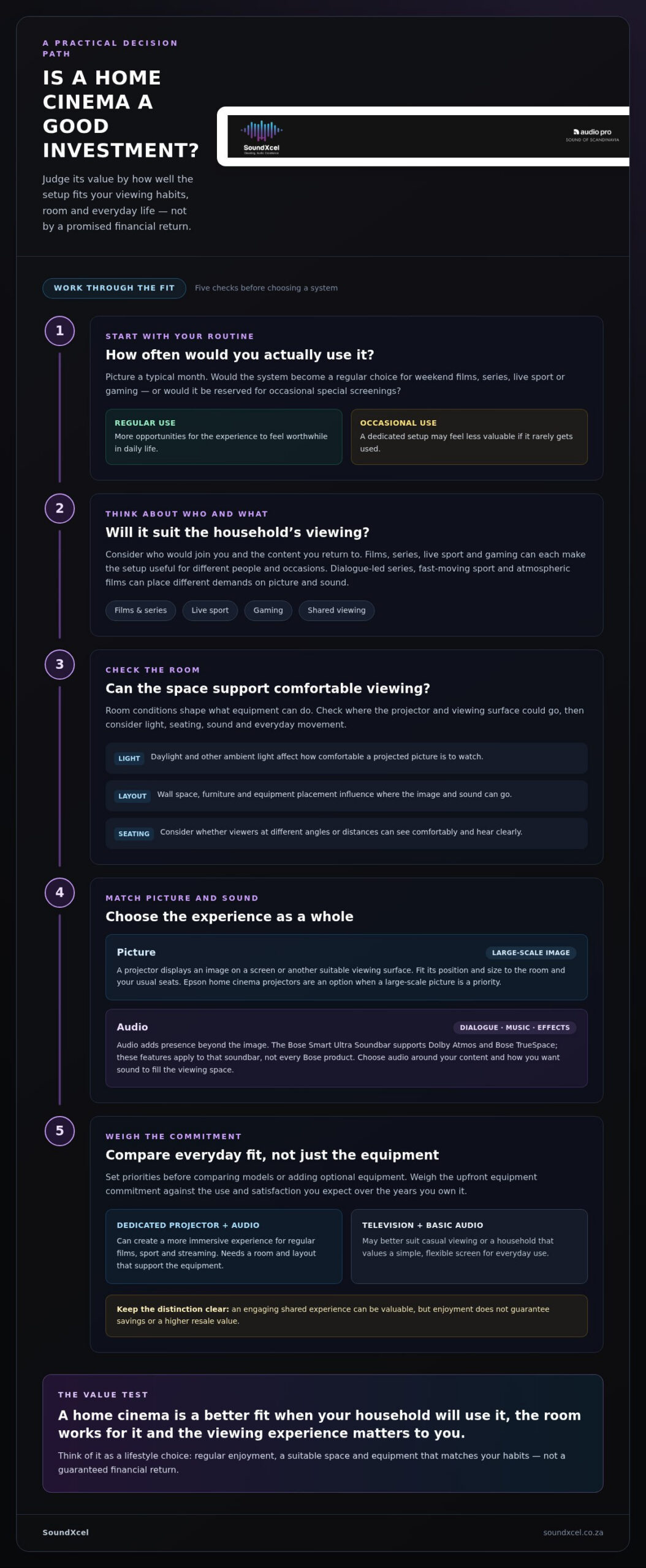
How to Decide Whether a Home Cinema Fits Your Space and Habits
Use a simple sequence before comparing equipment. It keeps the decision grounded in how you watch and what your room can support, rather than in features that may add little to your experience.
- Assess your use. Estimate how often you’d watch in a typical week or month, and who would join you. Note whether films, sport, series or gaming would be the main draw.
- Inspect the room. Record its dimensions, natural and artificial light, seating positions and possible locations for a projector, viewing surface and audio equipment.
- Set your priorities. Decide what matters most: a large picture, clear dialogue, immersive sound, shared viewing or a setup that stays unobtrusive between sessions.
- Compare equipment. Match suitable options to the room and priorities you’ve recorded. Consider how each component fits into the system before adding extras.
Estimate use honestly. If you expect regular family film nights, list who’ll be there and what you’d watch. If viewing is occasional, consider whether a simpler arrangement would meet the need. The aim isn’t to justify a particular system; it’s to identify the experience your household will actually make time for.
What should you assess before choosing home cinema equipment?
Write down the room’s dimensions and where daylight falls at the times you’re most likely to watch. Note available wall or screen space, the seating layout and possible projector placement. Then list your preferred content and whether dialogue clarity, impactful sound or a shared view across several seats matters most.
Take stock of equipment you already own, such as speakers or media devices. Treat it as a possible part of the plan, not an automatic match. Compatibility depends on the equipment, so consider how the pieces connect before building around them.
How can you prioritise features without overbuilding?
Separate essentials from optional additions. If your goal is a large picture for evening films, start with the room, viewing surface and projector choice. If the household mainly watches dialogue-led programmes, give sound clarity greater weight. Headline specifications matter less if the equipment doesn’t suit the space or your routine.
Build a complete budget before deciding. Include the main equipment, viewing surface, audio, required connections or mounting, and any power-management needs. In South Africa, it’s sensible to account for protection against power fluctuations as part of planning, rather than treating it as an afterthought. Keep optional accessories separate so you can see what supports your core experience.
When comparing projectors, look at the individual model’s specifications and how they relate to your room and intended use. Once you’ve mapped your habits, room and priorities, explore SoundXcel home cinema solutions to consider Epson projectors and Bose audio as part of a setup shaped around your needs.
Explore a Home Cinema with SoundXcel
A considered system starts with your household, not a product list. Think about who will watch, how often you’ll use the setup and what you want the picture and sound to deliver. Then match those priorities to the room: available viewing space, light, seating and practical equipment placement all help shape the right direction.
SoundXcel serves customers across South Africa with Epson home cinema projectors and premium Bose audio. These are complementary equipment categories, not a fixed package. You can focus first on a large projected picture, explore audio that suits your viewing, or consider both as parts of one experience.
What can SoundXcel help you explore for home cinema?
Use your room and viewing priorities to guide the projector search. Consider where the image will be viewed, when you’re most likely to watch and what content matters to your household. Those details offer a more useful starting point than choosing a projector on headline specifications alone.
Audio deserves its own consideration. Bose home entertainment audio can complement a projector setup, but it isn’t a universal requirement for every room or viewing style. The Bose Smart Ultra Soundbar supports Dolby Atmos and Bose TrueSpace, alongside AI Dialogue Mode. These features relate specifically to that soundbar and shouldn’t be assumed across all Bose products.
What is the next step after deciding a home cinema is worthwhile?
Build a short, needs-first equipment list before browsing. Keep it focused on what would make a noticeable difference to your household, and separate essential choices from optional additions. A simple outline can help you compare relevant categories without getting distracted by features that don’t support your intended experience.
- Viewing: Note your preferred content and the picture experience you want.
- Room: Record the available space, light conditions and possible equipment positions.
- Sound: Decide whether dialogue clarity, fuller sound or shared listening is a priority.
- Use: Estimate how often you’ll watch and who is likely to join you.
With those points in hand, browse Epson projector and Bose audio options at your own pace. Compare each category with your shortlist, then keep the overall system aligned with your room and routine. You don’t need to choose every component at once; a clear order of priorities makes it easier to assess what belongs in the setup and what can remain optional.
The question “is a home cinema a good investment” comes down to the experience you expect to enjoy, and whether the equipment fits your home and habits. SoundXcel brings relevant projector and audio categories together for South African households exploring that decision. Explore SoundXcel home cinema solutions and take the next step at your own pace.
Make Your Next Home Cinema Choice With Confidence
The right next step is to turn your viewing priorities into a focused equipment shortlist. Decide what you want the experience to feel like, then explore options that suit your space rather than building around features you may rarely use. That keeps the decision personal and practical.
So, is a home cinema a good investment? It can be when the setup fits your room and becomes part of how you enjoy time at home. Let your expected use guide the choice, and leave room to refine your plans as you compare picture and sound. SoundXcel brings Epson home cinema projectors and premium Bose audio into that exploration, including the Bose Smart Ultra Soundbar with Dolby Atmos, Bose TrueSpace and AI Dialogue Mode.
Explore SoundXcel home cinema solutions and take a considered next step towards a viewing experience that feels right for your household.
Frequently Asked Questions
Does a home cinema increase a property’s resale value?
No, a home cinema doesn’t guarantee a higher resale price. Its appeal to a future buyer will depend on their preferences and how the equipment fits the property. Treat the enjoyment you get from it as personal value, not a promised financial return. If you’re asking “is a home cinema a good investment”, make your decision based on your own expected use and regard any resale benefit as uncertain.
Is a home cinema worth it if I only watch films occasionally?
It may be, if those occasional screenings matter enough to you, but a dedicated setup could see limited use. Before committing, keep a short viewing diary and note how often you choose films at home, whether others join you and what would make those sessions more enjoyable. If the pattern is infrequent, a flexible setup that also works for everyday television may feel more useful than equipment reserved for special evenings.
Can I create a home cinema in a small room?
Yes, a small room can work if the picture, seating and equipment placement suit the available space. Measure the room, note where people will sit and check whether a projector can be positioned to create a comfortable image on a suitable surface. Leave practical access to equipment and avoid blocking walkways. If furniture or room use changes often, favour an arrangement that can adapt without dominating the space.
Is a projector suitable for daytime viewing at home?
It can be, but daylight and bright room lighting may make a projected image harder to see clearly. Consider when you’ll watch, how much light reaches the viewing area and whether curtains or blinds can help control it. A television may be a more convenient choice in a consistently bright room. Compare the specifications of individual projectors against your conditions, rather than assuming every model performs alike.
Can I build a home cinema gradually rather than buying everything at once?
Yes. Begin with the part that matters most to your viewing, then add other components as your needs become clearer. Before buying, check how each piece connects with equipment you already own; don’t assume compatibility. Include suitable surge protection or a UPS in your planning to help protect sensitive electronics from power fluctuations. A staged approach works best when each purchase supports a coherent system rather than becoming an isolated upgrade.
How much does a home cinema cost in South Africa?
There isn’t one reliable figure because a living-room setup and a dedicated cinema room involve different equipment and requirements. Build your budget around the projector or display, viewing surface, audio, connections, mounting, room treatments and power protection. Decide which items are essential before comparing options, and distinguish equipment from any room-related work. This gives you a clearer picture of the full commitment without relying on a price range that may not match your setup.
