


Bose SimpleSync Explained: How It Works and What Connects
October 3, 2026
What Is the Value of Vintage Bose Speakers? A South African Buyer’s Guide
October 5, 2026
What does “certified” on a speaker listing actually tell you? With certified pre-owned Bose speakers, the label is most useful when you know who assessed the item and what the assessment covered. It does not, by itself, mean Bose certified or endorsed that particular speaker.
It’s natural to want the listening experience Bose is known for while avoiding surprises about a speaker’s condition, faults or accessories. A clear description of the item and its assessment can help you compare a certified pre-loved speaker with a second-hand listing that provides less detail.
This guide explains what to look for in a certification claim, how to assess a pre-owned Bose speaker, and which ownership details to compare before choosing. You’ll also learn how certification differs from refurbishment, and why the seller matters. SoundXcel offers certified pre-loved Bose equipment to shoppers across South Africa, with a specialist Bose focus to support a more informed choice.
Key Takeaways
- Check who stands behind a certification claim and what the assessment covers.
- Compare item-specific details with the limited context often provided in second-hand listings.
- Choose certified pre-owned Bose speakers by matching the stated model and features to how you’ll use the speaker at home.
- Review model identity, condition, certification details and stated accessories as separate points.
- Explore SoundXcel’s marketplace for certified pre-loved Bose equipment when considering pre-owned audio.
Certified pre-owned Bose speakers: what the label should tell you
Pre-owned equipment has been owned or used before and is offered for resale. For certified pre-owned Bose speakers, “certified” should tell you more than that the speaker has had a previous owner. Look for the name of the assessor and a description of what the assessment covered.
A seller may use certification to describe its own documented assessment. That is different from saying Bose certified or endorsed the specific speaker. Look for clear supporting details instead of assuming the label refers to a manufacturer-backed standard. Certification describes a stated assessment, not a universal condition guarantee.
For a buyer’s perspective on refurbished Bose equipment, watch this video:
What can certified mean when buying a used Bose speaker?
Certification can refer to checks a seller has carried out and recorded. The label alone won’t tell you which functions were tested, what standards were used or whether the assessment was completed by the seller, a technician or the manufacturer. A useful description spells out the scope.
Keep different kinds of evidence separate. A statement that a speaker was tested may relate to its operation, but it doesn’t automatically describe its cosmetic condition or confirm which accessories come with it. Scratches, marks, packaging and included cables are separate details. Specific descriptions make it easier to judge whether the item fits your expectations.
Certified pre-owned, pre-loved and second-hand: how the terms differ
“Second-hand” is a broad term for equipment that has previously been owned or used. “Pre-loved” is a retail-friendly way to describe pre-owned audio equipment. Neither term, on its own, explains what checks have been carried out.
“Certified” should point to an identified assessment, rather than simply act as a reassuring label. Refurbishment can involve testing, grading or repairs, and sellers may use the term in different ways. The overview of Refurbishment (electronics) provides useful context, but the item description should explain the claim for that speaker. Look for the assessor, the stated checks and any distinction between functional testing, repairs and cosmetic grading.
Why consider certified pre-owned Bose speakers instead of unverified listings?
A documented assessment can give you a clearer picture of a particular speaker than a short listing with little supporting information. That context helps you compare its stated condition and other details before deciding whether a pre-owned option suits your needs. It doesn’t make the equipment new, flawless or immune to future faults.
Treat certification as a prompt to look for evidence, not a substitute for it. A useful account identifies what was assessed and keeps functional status, cosmetic condition and accessories distinct. An unverified listing may still describe a suitable speaker, but unclear details leave you with less information to compare.
What a documented assessment can help you understand
Item-specific notes can clarify which aspects of a speaker have been examined. For example, a description might state the results of functional checks, note visible marks or wear, and list the accessories supplied. These are separate categories: a working speaker may show cosmetic wear, and a functional assessment doesn’t establish what’s included.
Compare the stated scope with your priorities. If the speaker will be visible in your living space, condition details may matter to you. If it needs to connect to equipment you already own, clear model identification is important. Don’t assume one type of information answers another.
What certification does not automatically guarantee
The label alone doesn’t establish perfect condition, future performance, a warranty, return terms or included accessories. Those details should be stated separately for the item. A seller’s certification claim also isn’t the same as Bose factory refurbishment or manufacturer approval.
Bose describes its own programme separately in its Bose Certified Refurbished standards. That reference explains Bose’s manufacturer programme; it isn’t evidence that an individual pre-owned Bose speaker was certified or endorsed by Bose.
Use this comparison to judge how much context a listing provides:
| What to compare | Documented listing | Listing with little supporting context |
|---|---|---|
| Evidence | Describes the assessment and its scope | Uses a label without explaining its basis |
| Condition | Separates functional status from visible wear | Offers a broad description with few specifics |
| Item identity | Clearly identifies the speaker | Leaves the exact item or model unclear |
| Stated support | Sets out any applicable warranty or return terms | Doesn’t explain support terms |
Details can vary by item, so weigh each listing based on what it actually says, not on the label alone. To explore pre-loved Bose equipment with specialist context, browse SoundXcel’s pre-loved Bose equipment.
How to compare certified pre-owned Bose speakers
Start with the role the speaker needs to play. Is it mainly for music in one room, television audio or part of a wider home system? Consider where it will sit, how you’ll connect it to your existing equipment and whether you want a focused listening setup or sound across more than one space.
Then compare listings against those needs. Use model-specific details stated for the actual item, rather than assuming that features or performance are shared across Bose speakers. For broader planning, the Bose sound system selection guide can help you think through the system that suits your home.
Match the speaker to your room and listening habits
Think about placement and everyday use. A speaker for a television setup may need to fit your room layout and connect to the equipment you use. A music-focused speaker may suit a different space or routine. If you’re considering a wider home system, check the model identity and relevant details to assess how the speaker might fit. Avoid relying on broad performance claims unless the listing supports them with specifications.
Compare the details that matter in each listing
Clear model identification gives you a starting point. Next, read the condition description closely and distinguish it from the certification evidence. Review any stated support terms separately. Accessories should be treated as their own detail, too: an item shown in a photograph isn’t necessarily included unless the listing says so.
Use this framework to compare certified pre-owned Bose speakers consistently:
| Comparison point | What to look for in the listing |
|---|---|
| Intended use | Does the stated model and information suit music, television or your wider home system? |
| Condition details | Is the item’s condition described specifically, including visible wear where stated? |
| Certification evidence | Does the listing explain who assessed the speaker and what that assessment covered? |
| Stated inclusions | Are accessories explicitly listed, rather than only pictured? |
| Support terms | Are any applicable warranty or return terms set out for this item? |
Compare like with like, and note any gaps that matter to your intended setup. A listing with a clear model identity and item-specific details makes it easier to judge fit. A certification label alone can’t tell you whether the speaker meets your needs.
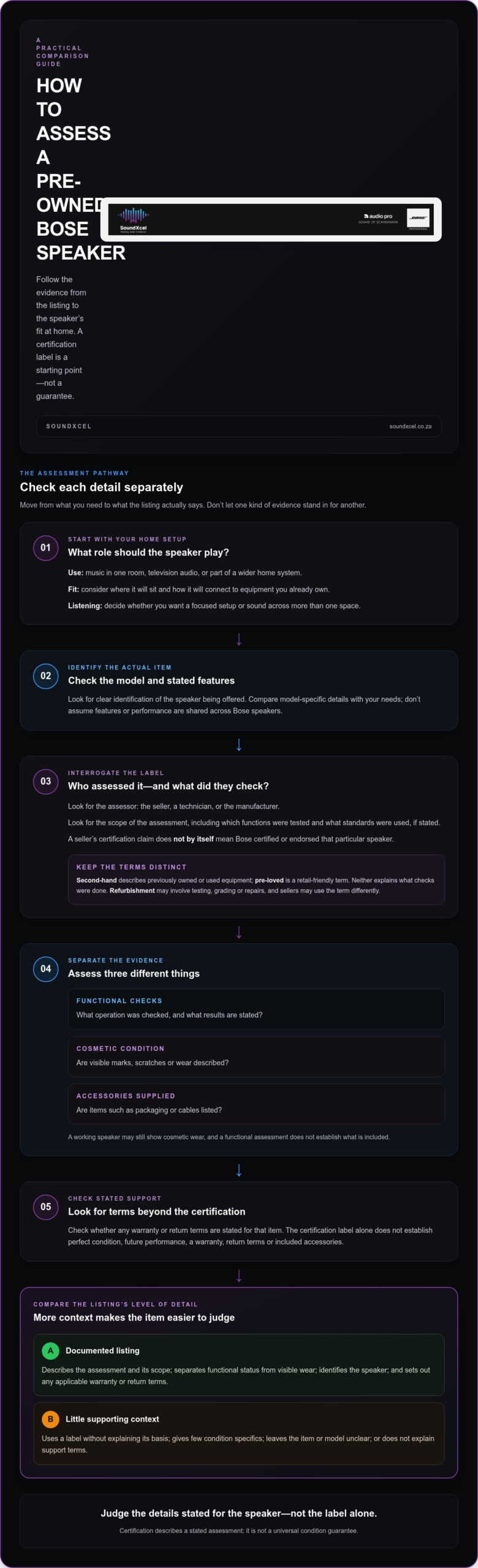
A practical checklist for assessing a pre-owned Bose speaker
Review each listing in a consistent order. Keep the speaker’s identity, condition, certification claim and included items separate, so a confident label or attractive photograph doesn’t distract from missing details.
An item’s stated condition describes its reported state; its certification claim describes an assessment. One doesn’t automatically prove the other. Use this checklist to evaluate the specific speaker you’re considering.
- Confirm the model and item identity. Check that the listing names the Bose speaker model clearly and relates to the specific item being sold. If photographs are provided, compare them with the description, but don’t assume an image alone verifies the model or its features.
- Read the functional condition description. Look for clear wording about the speaker’s reported operation. A general term such as “working” gives less context than an explanation of what has been assessed. Don’t infer that every function has been checked unless the listing says so.
- Assess cosmetic condition separately. Review notes about marks, scratches or other visible wear. Photos can help you interpret a condition description, but lighting and image angles can affect what you see. Treat them as evidence to consider, not proof that every detail is shown.
- Understand the certification scope. Look for a plain-language account of who certified or assessed the item and what that covered. Distinguish a seller’s own assessment from a claim of Bose manufacturer certification or endorsement. The word “certified” by itself doesn’t explain the checks or standard applied.
- Check the stated accessories. Read the item description for a clear list of what comes with the speaker. A cable, remote or other accessory visible in a photograph shouldn’t be assumed to be included unless it’s explicitly stated.
- Review support terms. Check any item-specific warranty, return or support information as a separate point. Certification alone doesn’t establish these terms, so don’t treat them as automatic benefits.
Use the same steps to compare certified pre-owned Bose speakers, giving more weight to specific, item-level information than to broad labels. If a detail matters to your setup, make sure it’s addressed in the listing before you decide.
Explore SoundXcel’s pre-loved Bose equipment as a considered route to pre-owned audio in South Africa.
Explore certified pre-owned Bose speakers with SoundXcel
Once you know what to look for, SoundXcel offers a destination in South Africa for exploring certified pre-loved Bose audio equipment. Its marketplace brings a specialist Bose focus to the pre-owned buying journey, giving you a place to review equipment with the questions from this guide in mind.
Keep each item’s details at the centre of your decision. The words “certified pre-loved” don’t, by themselves, mean Bose certified or endorsed a particular speaker. Read model identity, condition, certification scope, accessories and purchase terms as details specific to the individual item. This keeps expectations grounded and helps you compare a speaker with your intended use.
What to expect when exploring SoundXcel’s pre-loved Bose equipment
SoundXcel serves customers nationally in South Africa and offers certified pre-loved Bose equipment. Its Bose specialisation provides useful context as you assess your options, while item-level information helps you evaluate each speaker. Consider whether the listing describes the model clearly and explains what its certification claim covers. Base your assessment on the stated condition and terms for the speaker you’re considering.
Apply the same careful approach you’d use with any certified pre-owned Bose speakers: distinguish the seller’s stated assessment from manufacturer certification, and treat photographs as supporting context rather than a complete record. A clear understanding of the details can help you decide whether an item aligns with your priorities.
Plan for confident ownership after choosing
Keep a copy of the item description and applicable purchase terms for your records. This gives you a useful reference for the condition, inclusions and support arrangements stated at the time of purchase. It’s a simple way to keep the details of your chosen speaker organised.
SoundXcel also provides Bose-specific repairs, bringing relevant specialist context to Bose ownership. This is separate from the terms of a pre-loved purchase and shouldn’t be taken as a promise of repair coverage for a particular item. For more on this specialist area, read about professional Bose repair information.
Ready to take the next step? Explore certified pre-loved Bose speakers and review each listing with this guide in mind.
Choose your next Bose speaker with confidence
A considered purchase starts with clear information. For certified pre-owned Bose speakers, look beyond the label: identify who made the assessment, what it covered, and how the item’s condition and included accessories are described. Then match the stated model and details to how you plan to use it at home.
Certification can help you compare listings, but it isn’t a promise of flawless condition or future performance. Keep warranty, return or support terms separate, and review them as item-specific details. This approach helps you make a choice grounded in what’s actually stated.
SoundXcel offers certified pre-loved Bose audio equipment and specialises in Bose products and Bose-specific repairs. Explore the marketplace and apply the checklist to the listings that interest you.
Explore certified pre-loved Bose equipment at SoundXcel. Take the next step towards a listening setup that feels right for your home.
Frequently Asked Questions
What does certified pre-owned mean for Bose speakers?
It generally means a seller has assessed a previously owned speaker under a stated process. The phrase alone doesn’t tell you who performed the assessment, which checks were included or whether Bose was involved. For certified pre-owned Bose speakers, look for item-specific information identifying the assessor and the scope of the assessment. Treat condition, included accessories and support terms as separate details, not automatic parts of certification.
Are certified pre-owned Bose speakers certified by Bose?
Not necessarily. A seller may use “certified” to describe its own assessment, which is different from manufacturer certification or endorsement. Look for details that identify who assessed the speaker and what the assessment covered. Don’t assume Bose inspected, refurbished or approved a particular item unless the listing provides reliable evidence for that specific claim. A Bose name or logo alone doesn’t establish manufacturer certification.
Is a certified pre-owned Bose speaker better than a second-hand one?
Not automatically. A certification claim may come with clearer assessment information, but its value depends on the details provided. Compare the model identity, condition description, assessment scope and applicable purchase terms. A well-described second-hand listing can still offer useful context, whilst a certification label without supporting information may tell you little. Focus on the evidence for the specific speaker rather than relying on its category or label alone.
How can I check the condition of a pre-owned Bose speaker?
Start by checking the exact model and item description, then read functional and cosmetic condition details separately. Review the certification explanation and note which accessories are explicitly stated as included. Photos can help you interpret visible wear, but they can’t prove every aspect of condition or confirm what comes in the box. Treat any warranty, return or support terms as separate from assumptions about certification or future performance.
Do certified pre-owned Bose speakers come with a warranty?
Certification doesn’t automatically mean a warranty is included. Any warranty or support depends on the terms stated for the specific item, so don’t infer coverage from the word “certified”. Read the purchase terms for any stated duration, scope and conditions. If the listing doesn’t set out a warranty, don’t treat it as a promised benefit. Keep the item description and applicable terms for reference after purchase.
Can I use a pre-owned Bose speaker with my existing audio system?
Compatibility depends on the exact speaker model and the equipment in your setup. Identify the model, then compare its documented connections and supported functions with how you plan to use it. The Bose name alone doesn’t mean every speaker works with every system. For broader planning, SoundXcel’s Bose sound system guide can help you consider how a speaker may fit into your home audio setup.
Where can I buy certified pre-owned Bose speakers in South Africa?
SoundXcel offers a marketplace for certified pre-loved Bose audio equipment and serves customers nationally in South Africa. Review each listing for the speaker’s model, condition description, certification scope and stated terms. SoundXcel specialises in Bose products and also provides Bose-specific repairs, which are separate from a pre-owned purchase. SoundXcel’s pre-loved Bose buyer’s guide offers further context as you compare your options.
