


How to Reset a Bose Soundbar: A Complete Troubleshooting Guide (2026)
August 5, 2026
What is a Laser TV? The Ultimate Guide to Ultra Short Throw Cinema in 2026
August 8, 2026
Your premium Bose system isn’t failing; it is simply experiencing a natural material transition that affects even the finest components. You’ve likely noticed the tell-tale signs: distorted bass at high volumes or grey flakes of debris appearing behind the grilles. It’s frustrating to see a high-end investment lose its edge, especially when you’re worried that a cheap, generic DIY kit might permanently damage the driver. Mastering the process of Bose speaker foam rot repair is essential for any audiophile who values acoustic precision and specialised craftsmanship.
We agree that your sound system deserves more than a temporary patch. This guide promises to show you how to identify, evaluate, and professionally resolve foam degradation to restore your equipment to its original factory performance. You’ll gain a clear understanding of driver architecture and find a trusted path to expert repair services in South Africa, ensuring your audio remains crisp, clear, and powerful.
Key Takeaways
- Recognise that foam rot is the inevitable chemical degradation of polyurethane surrounds, often accelerated by local environmental factors like humidity.
- Identify critical symptoms such as sticky residue or visible holes in the speaker ring to prevent long-term acoustic damage to your system.
- Evaluate the risks of generic DIY kits versus professional Bose speaker foam rot repair to ensure perfect voice coil alignment and sound quality.
- Understand the technical restoration process required to match the exact density and profile of your specific Bose driver for factory-standard performance.
- Learn how specialised restoration services in South Africa preserve the value and heritage of premium systems like the Bose Lifestyle collection.
What is Bose Speaker Foam Rot and Why Does it Occur?
Foam rot is the chemical breakdown of the polyurethane surround, the flexible ring that anchors the speaker cone to its metal frame. This component is vital because it provides the “acoustic suspension” required for the driver to move with precision and control. When the foam fails, the cone loses its centring, resulting in distorted sound and potential damage to the internal voice coil. Understanding the mechanics of Loudspeaker components helps clarify why this flexible ring is so critical to your system’s performance. If you’ve discovered grey flakes beneath your grilles, you’re likely facing a necessary Bose speaker foam rot repair to save your heritage gear.
The degradation isn’t a sign of poor manufacturing but rather a limitation of the materials available during the peak era of analogue audio. Bose speakers from the 70s, 80s, and 90s are particularly susceptible because the polyurethane used in those decades has a finite lifespan. It’s a silent process that happens regardless of how often you play your music. In fact, speakers left in storage for years often exhibit worse decay than those in daily use.
The Science of Polyurethane Degradation
The primary culprit behind this decay is a process called hydrolysis. Moisture in the air reacts with the chemical bonds in the polyurethane, causing them to snap over time. In South Africa, our varied climate—from the humid coastal air of KwaZulu-Natal to the intense UV exposure in the Highveld—accelerates this breakdown. You’ll notice the foam either becomes “tacky” and sticky to the touch or turns into a brittle, grey dust that spills out of the speaker grilles. Once the elasticity is gone, the speaker can no longer produce the deep, controlled bass that Bose is famous for.
Bose Models Most Affected by Foam Rot
Iconic units like the Bose 901, 501, and the 301 Series frequently require attention due to their age and driver design. Even modern setups like the Bose Lifestyle collection aren’t immune to the passage of time, especially in harsher environments. The good news is that the driver itself, including the magnet and voice coil, usually remains in perfect condition. A professional Bose speaker foam rot repair focuses on replacing only the perished surround, which effectively resets the clock on your equipment’s lifespan. By restoring the suspension, you maintain the integrity of the original acoustic design without needing to replace the entire unit.
Key Symptoms: How to Tell if Your Speakers Require Specialist Repair
Identifying the need for Bose speaker foam rot repair starts with simple observation. You don’t need to be a sound engineer to spot the warning signs. Most Bose components are built to last decades, but the foam surround is a perishable element that eventually requires attention. Ignoring early symptoms can lead to permanent driver failure and a far more expensive restoration project.
The Visual Inspection Test
Start by removing the speaker grilles. Most Bose models use simple friction fits or plastic clips. Once the driver is exposed, examine the outer ring of the cone. Look for visible cracks, small holes, or areas where the material has thinned. Dry rot is the loss of structural integrity in the foam surround, causing it to fail when the cone moves. In some Bose Lifestyle systems, the foam is tucked behind the frame or oriented downwards, making it harder to spot. Use a torch to check for debris or “flaking” at the base of the cabinet. Whilst some enthusiasts might research a DIY speaker repair, a visual check often reveals damage that requires professional precision to fix correctly.
Don’t forget the tactile test. Gently touch the edge of the foam with a clean finger. If the material feels “tacky” or leaves a sticky residue, the chemical breakdown is advanced. If the foam crumbles into dust under the lightest pressure, the suspension has already failed. At this stage, the cone is essentially floating without support, which puts immense strain on the internal components.
Acoustic Distortions to Listen For
Your ears will often detect foam rot before your eyes do. Listen for a distinct “farting” or flapping sound during bass-heavy tracks. This occurs because the cone is no longer held in a linear path. You might also notice a significant loss of punch and clarity in lower frequencies. The sound becomes muddy and lacks the tight, responsive bass characteristic of a healthy Bose system. A particularly dangerous symptom is voice coil rub. Without the foam surround to centre the cone, the voice coil may sag and scrape against the magnet assembly. This creates a harsh, metallic rattling sound that indicates imminent failure.
These symptoms often only appear at higher volumes. At low-level listening, the driver’s excursion is minimal, so the speaker may sound normal. Once you turn up the volume, the lack of suspension causes the driver to over-extend. Continuing to play music under these conditions risks burning out the voice coil entirely. If your audio has lost its edge, it’s best to consult our repair specialists before permanent damage occurs.
Evaluating the Risks: DIY Foam Repair Kits vs. Professional Refoaming
When faced with crumbling surrounds, the temptation to order a cheap kit from a generic online marketplace is strong. These kits promise a quick fix for a fraction of the cost of a specialist service. However, Bose speaker foam rot repair requires significantly more than just a tube of glue and a generic ring of foam. Most budget kits provide “one-size-fits-all” surrounds that lack the specific compliance and density required for Bose’s unique driver architectures. Using a surround that is too stiff or too loose fundamentally alters the speaker’s frequency response, turning a precision instrument into a mediocre noisemaker.
The Hidden Dangers of DIY Refoaming
The most significant risk involves voice coil misalignment. The gap between the voice coil and the magnet is often less than a millimetre. If the new foam isn’t centred with surgical precision, the coil will rub against the magnet assembly. This creates a scratching sound and eventually wears through the delicate wire insulation, causing a permanent short circuit. Removing old, petrified adhesive also poses a threat. Without the correct solvents, it’s incredibly easy to tear the paper cone or damage the spider. In the pursuit of a “cheap” repair, many enthusiasts end up destroying the very drivers they sought to save.
Why Professional Restoration Wins
Professional restoration eliminates these variables by using industrial-grade adhesives specifically formulated to bond with Bose materials without causing warping. Specialists employ advanced centring techniques, such as using a low-frequency sine wave generator to ensure the cone moves perfectly vertically whilst the adhesive cures. This level of accuracy is nearly impossible to achieve on a kitchen table. Investing in expert care preserves the market value and acoustic integrity of your Pre-Loved Bose Equipment, ensuring your system performs exactly as the engineers intended. You aren’t just paying for a part; you’re paying for the guarantee that your premium audio investment remains a masterpiece of sound.
Choosing a professional path also ensures that the foam used is a direct match for the original factory specifications. Generic kits often use foams that are too thick, which increases the mass of the cone and kills the high-end detail Bose is known for. A professional technician understands the balance between durability and acoustic transparency, providing a repair that lasts for another twenty years without compromising the “Bose sound.”
The Technical Restoration Process: Ensuring Long-Term Durability
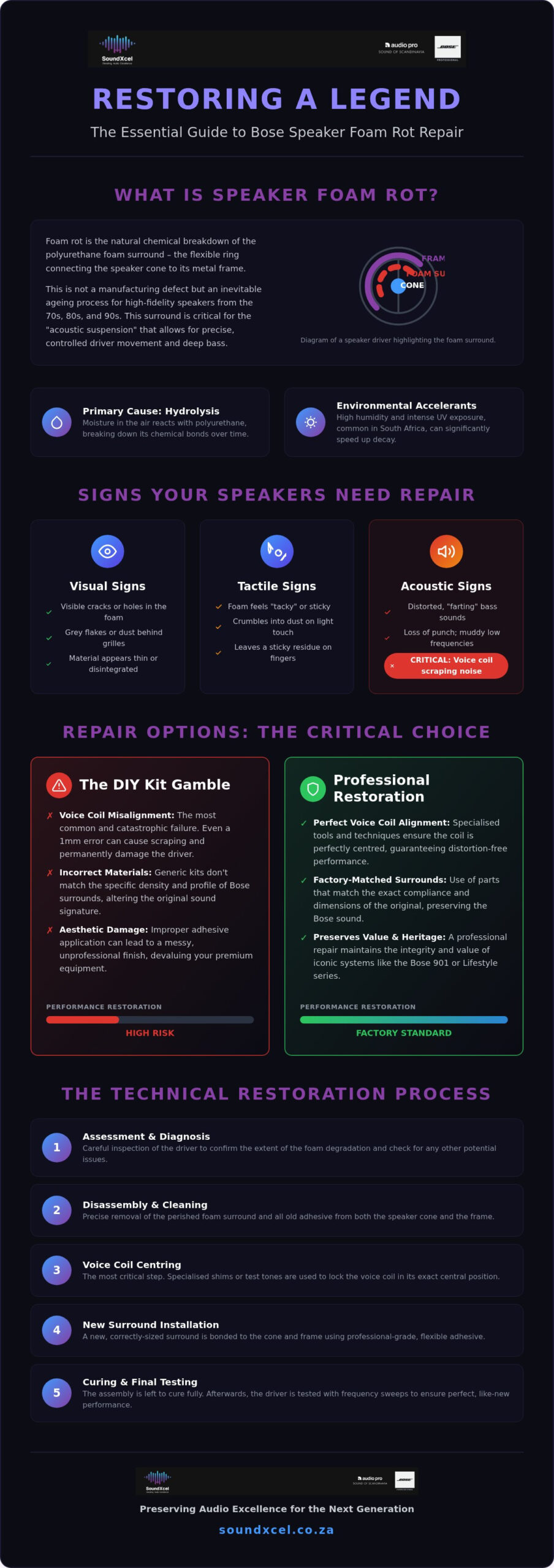
Professional Bose speaker foam rot repair is a methodical sequence that prioritises structural integrity and acoustic fidelity. It starts with stripping the driver down to the bare frame. Every trace of the original, petrified surround must be removed to ensure the new component bonds perfectly. This isn’t just about aesthetics; it’s about creating a surface that can withstand thousands of oscillations per second without failing. A professional approach ensures that the driver is reset to its original engineering tolerances rather than just being patched up.
Precision Cleaning and Surface Prep
We use model-specific solvents to dissolve old adhesives without compromising the delicate paper or composite cone material. The meticulous removal of old adhesives is the foundation of a successful repair. A pristine bonding surface ensures the new surround won’t lift or peel under heavy bass loads. This preparation stage is often where DIY attempts fail, as residual glue prevents a uniform seal and can lead to air leaks that ruin the “acoustic suspension” Bose is famous for. We take the time to scrape and clean both the cone edge and the metal basket until the surfaces are surgically clean.
Once the frame is prepped, we select a replacement surround that matches the original Bose density and profile. Bose drivers use specific compliance ratings that dictate how easily the cone moves. A surround that is too stiff will “choke” the sound, whilst one that is too soft will allow the cone to over-extend and potentially damage the voice coil. Our matching process ensures the restored driver meets these exact engineering specifications. We apply industrial-grade adhesives in a controlled environment to prevent dust contamination or humidity-related curing issues. Whilst the glue is still tacky, we centre the voice coil with absolute accuracy, ensuring it sits perfectly in the magnetic gap.
Testing and Quality Assurance
Restoration concludes with rigorous testing to ensure the repair will last for decades. We run low-frequency sweeps to detect any mechanical interference or “buzzing” that might indicate a centring issue. This verifies that the driver’s excursion is uniform and unrestricted across its entire frequency range. If the cone isn’t moving perfectly vertically, the sweep will reveal even the slightest friction. Finally, we inspect the aesthetic finish to ensure it looks as professional as it sounds, maintaining the visual heritage of your equipment.
Your restored speakers should look and perform like they just left the factory. We don’t consider a job complete until the driver passes a high-output stress test, confirming the bond is secure and the acoustic output is balanced. This attention to detail preserves the longevity of your system and protects your investment. Ready to bring your system back to life? Book your Bose Repairs today and experience the difference of a professional restoration.
Expert Bose Speaker Restoration and Repairs at SoundXcel
SoundXcel stands as South Africa’s leading specialist for high-end audio restoration. We understand the unique engineering behind every driver, making us the trusted choice for Bose speaker foam rot repair. Our technicians combine technical precision with a passion for acoustic heritage. Whether you own a vintage pair of 301s or a sophisticated system from the Bose Lifestyle collection, we ensure your equipment returns to its peak performance levels. We don’t just fix speakers; we preserve the signature sound profile that defines the Bose experience.
Comprehensive Bose Support Across South Africa
Distance shouldn’t be a barrier to quality sound. We manage national repairs with a streamlined process designed for your convenience and peace of mind. Our expertise extends across the entire ecosystem, from legacy hardware to modern innovations. This includes the Professional Bose Repairs we perform daily on everything from headphones to complex home cinema drivers. We also support the Bose DesignMax series, ensuring that commercial and residential installations maintain their clarity and impact. Our team handles every unit with the care it deserves, providing a level of reliability that generic repair shops simply cannot match.
Protecting Your Audio Investment
Choosing to restore your system is a sustainable decision that honours the quality of the original build. It’s often far more cost-effective to perform a Bose speaker foam rot repair than to replace a high-performance system entirely. If you’re looking to expand your collection or find a specific component, you can also explore our curated range of Pre-Loved Bose Equipment. This marketplace offers a second life to premium gear, all verified and restored by our expert technicians to meet factory standards.
Sometimes, a restoration is the perfect moment to consider an upgrade to the latest technology. We offer pathways to transition into new gear, such as the Bose QuietComfort Ultra Headphones or the Bose Ultra Open Earbuds for your mobile listening needs. For those seeking the pinnacle of home cinema, we provide expert guidance on the latest Bose Lifestyle systems and Epson Home Cinema Projectors. Contact our team today to organise a professional assessment of your speakers. We’ll help you decide whether a precision repair or a modern upgrade best suits your lifestyle and listening habits.
Restore Your Sound Heritage
Your Bose system represents a significant investment in acoustic engineering. Whilst foam degradation is inevitable, it doesn’t have to be the end of your audio journey. By identifying the early signs of wear and choosing professional Bose speaker foam rot repair over generic DIY kits, you preserve the precise voice coil alignment and tonal balance that define the brand. Expert restoration effectively resets the clock on your drivers, ensuring they deliver powerful, distortion-free sound for another generation.
As an authorised Bose and Epson specialist, SoundXcel operates an expert technical repair centre that serves enthusiasts across South Africa. We take pride in our national service, providing reliable restoration for both legacy hardware and modern systems. Don’t let crumbling surrounds compromise your listening experience or risk permanent driver damage with substandard parts. Our methodical approach guarantees that every component meets factory specifications.
Restore your Bose system with SoundXcel’s professional repair services and bring the depth and clarity back to your favourite tracks today. We’re here to help you rediscover the premium performance you’ve always loved.
Frequently Asked Questions
Is it worth repairing foam rot on old Bose speakers?
Yes, restoring classic Bose drivers is almost always worthwhile because the build quality of legacy magnets and voice coils often exceeds modern entry-level alternatives. A professional repair costs a fraction of the price of a new premium system. It preserves the unique acoustic signature of your equipment whilst extending its lifespan for another two decades.
Can I use any generic foam kit for my Bose 901 speakers?
No, you should avoid generic kits because they rarely match the specific compliance and excursion requirements of the 901’s unique driver array. Using the wrong material will alter the frequency response and can choke the bass output. Specialist Bose speaker foam rot repair requires model-specific surrounds to maintain the intended Direct/Reflecting soundstage and tonal balance.
How long does a professional Bose speaker refoaming last?
A professional refoaming typically lasts between 15 and 25 years depending on your local environment and usage patterns. Modern polyurethane compounds are often more resilient than the original materials used in the 1980s. Keeping your speakers in a climate-controlled room away from direct sunlight and high humidity will maximise the longevity of the new surrounds.
What happens if I continue to use speakers with rotted foam?
You risk permanent damage to the voice coil if you continue to play music through rotted surrounds. Without the foam to centre the cone, the coil will sag and rub against the magnet assembly. This friction eventually wears through the wire insulation, leading to a short circuit that renders the driver unrepairable and requires a full replacement.
Does foam rot affect Bose noise-cancelling headphones?
No, foam rot specifically affects the suspension of loudspeaker drivers rather than noise-cancelling headphones. However, the synthetic protein leather on headphone ear pads does perish and flake over time due to skin oils and friction. We offer replacements for these components to ensure your QuietComfort Ultra or legacy models remain comfortable and provide a perfect acoustic seal.
How much does it typically cost to repair Bose speaker foam rot in South Africa?
Repair costs vary based on the specific model and the total number of drivers requiring attention. A Bose 901 system with eighteen drivers requires significantly more labour and materials than a standard pair of bookshelf speakers. We recommend booking a professional assessment at our technical centre to receive an accurate quote tailored to your specific restoration needs.
Can SoundXcel repair the foam on my Bose Lifestyle Acoustimass module?
Yes, we specialise in restoring the internal drivers found within Bose Lifestyle Acoustimass modules. These subwoofers often hide foam rot until the bass becomes noticeably muddy or begins to rattle. Our technicians can access these internal components to perform a Bose speaker foam rot repair, restoring the deep, punchy low-end performance your home cinema system was designed to deliver.
Do you provide a warranty on Bose speaker repairs?
Yes, we provide a professional guarantee on all our speaker restoration work to ensure your peace of mind. This covers the integrity of the adhesive bond and the precise alignment of the driver components. We stand by our craftsmanship and the industrial-grade materials we use, ensuring your restored Bose system performs reliably for many years to come.
