

Projector Screen Size Calculator: How to Calculate Dimensions and Distance in 2026
September 24, 2026
Bose Headphone Repair South Africa: How to Get Your Headphones Assessed
September 26, 2026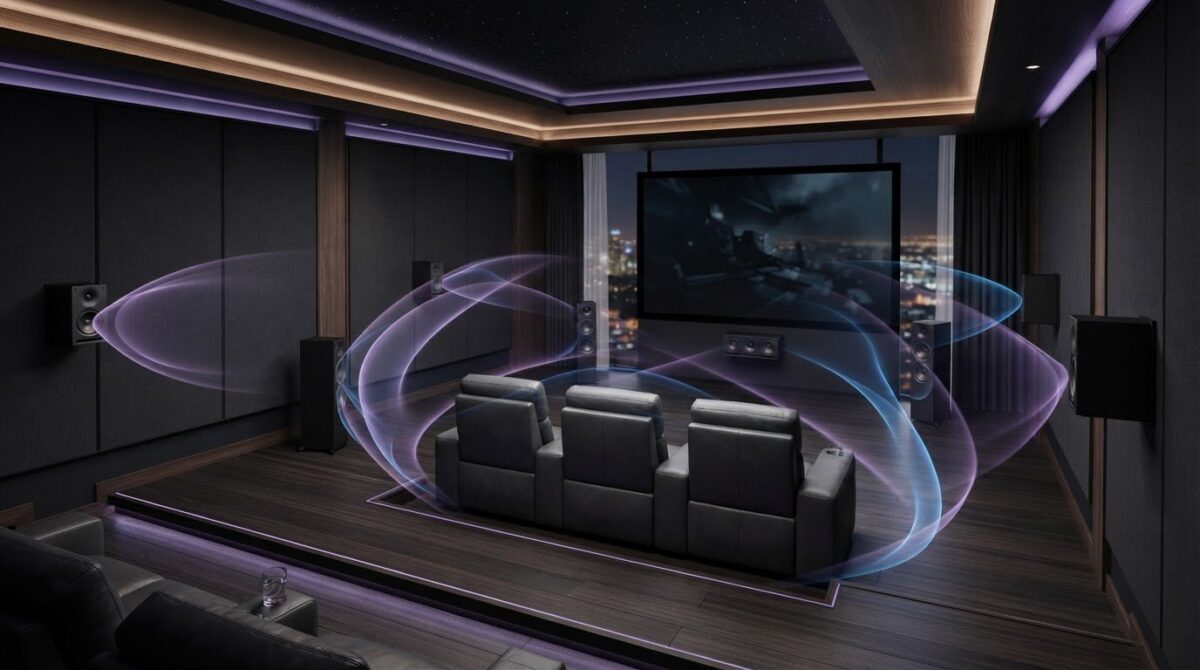
What if the best surround setup starts with your listening seat, not your speakers? This surround sound speaker placement guide begins with the position where you watch, listen and play. Get the angles wrong, and dialogue can feel detached while effects seem to come from the wrong place. A few well-positioned speakers can create a more convincing sound field than simply adding more equipment.
It’s easy to feel unsure when your room has an open layout, furniture in the way or few practical mounting options. Start with a clear layout, then adapt it to your seating, room boundaries and system. In a 5.1 setup, for example, surround speakers generally sit to the sides of the main listening position, rather than directly behind it. Check your speaker and AV receiver instructions for guidance specific to your equipment.
Below, learn how to position each speaker, work around common room constraints and test the result methodically. We’ll also explain why placement advice differs for separate surround speakers and soundbar-based immersive audio, so you can choose adjustments that suit your setup.
Key Takeaways
- Build your layout around the main listening seat, then check your equipment manuals before settling on positions.
- Understand what each speaker contributes and where to begin placing it for a more coherent sound field.
- Adapt your setup to open layouts, compact rooms and asymmetrical spaces without assuming every speaker must sit in a perfectly balanced position.
- Change one speaker position at a time and listen for the effect of each adjustment.
- Compare separate-speaker systems with soundbar-based immersive audio to find an approach that suits your room and preferences.
Surround Sound Speaker Placement: Start with the Listening Position
Surround sound placement means arranging speakers in relation to a main seat so that sound forms a coherent field around the listener. Start with that seat, not with the room’s most convenient corners. This surround sound speaker placement guide uses the listening position as its reference point because each speaker’s direction and distance affect how dialogue, music and effects come together.
The listening position is the seat you use most, and the reference point for arranging every speaker around you. A separate-speaker system places speakers at different points around this position. A soundbar-based immersive system creates its effect differently, so follow the instructions for your specific equipment rather than applying a separate-speaker diagram to it.
For a practical look at connecting a receiver as part of a home cinema setup, watch this video:
Identify the main listening position before moving speakers
Choose the seat most often used for films, television and gaming. Mark its centre and use it as the anchor for your layout. If several people regularly sit across a sofa, a single ideal position may not serve everyone equally. Aim for a balanced arrangement around the main seating area, while recognising that listeners at the edges may hear different levels or directions.
Room diagrams are useful starting points, not templates. A doorway, open-plan layout or large piece of furniture may make a textbook position impractical. Adapt the layout to the actual room and seating, and check your speaker and receiver manuals for equipment-specific placement guidance.
Recognise the roles of front, centre and surround speakers
The front left and right speakers establish the soundstage in front of you, supporting music, atmosphere and effects that belong on screen. A centre speaker, when included, typically anchors dialogue near the picture. Surround channels add environmental sounds around the listener, such as a passing vehicle or activity in a crowd, helping the scene feel more enveloping.
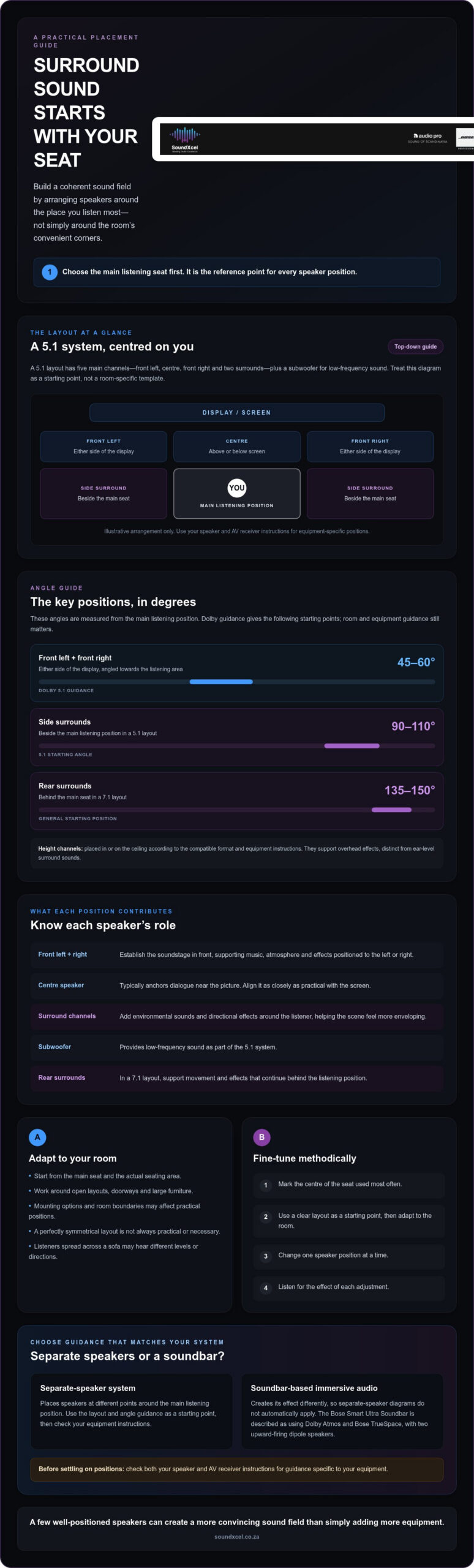
In a standard 5.1 layout, the five main channels are front left, centre, front right and two surrounds, alongside a subwoofer for low-frequency sound. The 5.1 surround sound overview explains this foundational arrangement and the roles of its speakers. Use it to understand the layout, then check placement recommendations against your equipment instructions. A soundbar, such as the Bose Smart Ultra Soundbar, uses Dolby Atmos and Bose TrueSpace, with two upward-firing dipole speakers. Its placement guidance differs from that for separate surround speakers.
Where to Place Each Surround Sound Speaker Around Your Seat
Use the main listening seat as your reference, then arrange speakers to create a balanced field around it. The positions below are practical starting points, not universal measurements. Room shape, speaker design and receiver settings all matter, so check the guidance for your equipment before mounting speakers or finalising their positions.
| Speaker role | Starting position | What it supports |
|---|---|---|
| Front left and right | Either side of the display, angled towards the listening area. Dolby’s 5.1 guidance places them 45-60 degrees from the seat. | The front soundstage, including music and effects positioned to the left or right. |
| Centre | Above or below the display, aligned as closely as practical with the screen. | Dialogue anchored near the picture. |
| Side surrounds | Beside the main seat; a 5.1 starting angle is 90-110 degrees. | Ambient and directional effects around the listener. |
| Rear surrounds | Behind the main seat in a 7.1 layout, generally at 135-150 degrees. | Movement and effects that continue behind the listening position. |
| Height channels | In or on the ceiling, positioned according to the compatible format and equipment instructions. | Overhead effects, distinct from ear-level surround sounds. |
Position the front and centre speakers for a stable soundstage
Place the front left and right speakers around the display, using the manufacturer’s recommendations for spacing and direction. Aim for a convincing front image that reaches the main seat without one side dominating. If your system includes a centre speaker, align it with the screen where possible. Poor alignment between the seat, display and centre channel can make dialogue seem detached from the action or uneven across seats.
Set up surround and height speakers for convincing movement
For a 5.1 system, begin with the surrounds to the sides of the listening position. In a 7.1 layout, add rear surrounds behind the seat. These ear-level channels create the sense of sounds moving around you; height or ceiling channels add a separate overhead dimension. Don’t treat a high-mounted surround as a substitute for a dedicated height channel.
Height effects depend on a compatible format, receiver and speaker configuration. Dolby Atmos layouts vary, so confirm that your equipment supports the arrangement you plan to use. Dolby’s home theatre setup guide offers further placement principles. Apply its diagrams only where they match your system. Listener-level speakers are generally intended to sit near seated ear height, but follow your speaker instructions if they specify otherwise.
In brief: front channels establish the scene, the centre anchors dialogue, surrounds bring effects around the seat, and height channels add overhead sound. If you’re considering a soundbar-based immersive system rather than separate speakers, explore Bose audio solutions from SoundXcel and check the product-specific placement guidance.
Surround Sound Placement for Open, Small or Asymmetrical Rooms
A balanced layout is a useful starting point, but homes rarely match a diagram perfectly. An open side, an alcove or a sofa pushed against a wall can change how sound reaches the listening area. Rather than forcing the room into a symmetrical arrangement, use the main seat as your reference and test practical positions around it. Treat this surround sound speaker placement guide as a framework, then check your speaker and receiver instructions for system-specific advice.
Adapt speaker positions in open-plan or asymmetrical spaces
In an open-plan room, sound from one surround speaker may seem less defined because there’s no nearby wall to reflect it, whilst the other side has a boundary. An asymmetrical room can create a similar difference in perceived direction or level. Symmetry is a helpful first attempt because it gives the left and right sides a balanced basis, but it isn’t a rule to follow at the expense of a usable layout.
Try placing the speakers at practical points beside or behind the main seating area, then listen from the seat you use most. If one side feels more prominent, adjust its position in small steps and compare familiar dialogue or effects. Dolby’s speaker setup guide provides layout references for different configurations. Use the diagram for your system as a starting point, not as a substitute for the manufacturer’s instructions.
Work around furniture, walls and limited mounting options
A sofa may block a low speaker, a cabinet may restrict its direction, or a walkway may rule out a stand. Look for a position that keeps the speaker stable, clear of everyday traffic and aimed as the manufacturer recommends. Avoid placing equipment where it can be knocked, obstructed or left insecure. If mounting is an option, check the product instructions before choosing hardware, as compatibility and requirements vary by speaker.
Keep the trade-off clear. Ideal placement can support a more balanced, consistent sound field, but may not be practical in a lived-in room. A room-specific compromise can preserve clear pathways and secure positioning, though effects may feel less even from every seat. For example, moving a speaker slightly to avoid a doorway may work better for daily use than insisting on a textbook position that blocks circulation. Test the change from your main seat and, if others regularly listen with you, check how it sounds from their seats too.
- Prioritise: a secure position, clear pathways and guidance for your exact equipment.
- Then refine: adjust one speaker at a time and listen for changes in balance and direction.
How to Set Up and Fine-Tune Surround Sound Speaker Placement
A repeatable process makes adjustments easier to judge. Use this surround sound speaker placement guide as a practical sequence, alongside the layout and connection instructions for your specific speakers and receiver. Don’t change several positions at once. If the sound improves or worsens, you’ll want to know which adjustment made the difference.
Follow a repeatable placement and calibration sequence
- 1. Mark the seat. Identify the main listening position and note its centre. Keep this reference point consistent during setup.
- 2. Check your system layout. Use the manufacturer’s recommended arrangement for your speaker configuration. Confirm which connections and settings apply to your equipment.
- 3. Position and connect speakers safely. Place each speaker where it’s stable and unobstructed. Connect the system according to the manuals before switching it on.
- 4. Record the starting point. Note speaker positions and any receiver settings you change. This makes it easier to compare results or return to the original setup.
- 5. Run supported calibration. If your receiver includes a room-calibration process, follow its instructions after positioning the speakers. Calibration can help adjust the system, but it can’t make an obstructed or poorly placed speaker ideal.
Calibration features vary by equipment. Check your receiver’s manual to confirm whether it offers them and how to use them. Don’t assume that a feature or diagram applies to every system.
Test dialogue, effects and balance with familiar content
Choose a film, programme or game you know well. Familiar content makes it easier to notice whether a change has helped. Listen from the main seat, and keep the volume consistent between tests so that louder playback doesn’t disguise a placement issue.
First listening test: Is dialogue clear? Do effects move convincingly? Are speaker levels balanced? Is any speaker obstructed?
If dialogue seems unclear or effects feel misplaced, change one speaker position or receiver setting, then replay the same passage. For example, adjust a surround speaker before changing its level. Write down what you changed and what you heard. If the result is less convincing, reverse that adjustment and test another option. Small, controlled comparisons are more useful than moving several speakers and relying on memory.
Check the system from the seat you use most, then consider how it sounds from other regular seats. Fine-tuning is about finding a practical balance for your room, not chasing a perfect result from a diagram.
For help exploring premium Bose audio options for your home, view Bose audio solutions at SoundXcel.
Choose a Surround Sound Approach That Fits Your Home
The right system depends on how you use your room, where people sit and how much flexibility you have for placing speakers. A dedicated surround setup may suit a room where you can position separate speakers around the seating area. A soundbar-based immersive system may be more practical when space, furniture or a preference for fewer separate components shapes the decision. Neither approach is right for every home.
Compare separate speakers with soundbar-based immersive audio
Separate speakers create the sound field through individual units placed around the listening position. A soundbar uses a different design and should be set up according to its own instructions, not treated as a substitute for discrete surround speakers. The placement options available depend on the system, its supported formats and the shape of the room.
For example, the Bose Smart Ultra Soundbar supports Dolby Atmos and Bose TrueSpace, and has two upward-firing dipole speakers. Its product-specific placement guidance applies to soundbar-based immersive audio. Separate-speaker diagrams, by contrast, apply to the system layouts they describe. When comparing options, read the equipment instructions and use placement guidance for the system it covers.
Make your next step an informed equipment decision
Before choosing, think about the listening experience you want and the practical limits of your room. Can you place speakers beside or behind the main seating area? Are ceiling or wall positions suitable for the system you’re considering? Would a soundbar’s format better suit your layout? These questions help narrow the options without assuming one system will work equally well in every space.
Check format and equipment compatibility, connection requirements and the manufacturer’s setup instructions before you commit. If you’re comparing a soundbar with a separate-speaker arrangement, assess each on its own terms. Both can support an engaging home cinema experience, but they create sound differently and have different placement needs.
Use this surround sound speaker placement guide as a starting point, then match your system to your room and listening priorities. Explore Bose audio solutions at SoundXcel as you consider which approach feels right for your home.
Build a Sound Experience That Works for Your Home
A well-planned setup begins with the listening position, then adapts to the room rather than forcing a perfect diagram. Use your equipment’s instructions as the authority for placement, and make careful adjustments one at a time. This surround sound speaker placement guide also highlights an important choice: separate speakers and soundbar-based immersive audio create sound differently, so match the approach to your space and listening priorities.
If you’re considering Bose, the Bose Smart Ultra Soundbar features Dolby Atmos and Bose TrueSpace technology. It’s a soundbar-based option, not a replacement for the distinct placement choices of a separate-speaker system. SoundXcel is an independent authorised retailer and installer of Bose and premium AV brands in South Africa, so you can explore its Bose range as part of your research.
With a setup suited to your room and the right placement for your equipment, you can create a more engaging home listening experience.
Frequently Asked Questions
Where should surround sound speakers be placed?
Place surround speakers around the main listening position, following the layout recommended for your system. As a starting point, a 5.1 system’s side surrounds sit to the sides of the seat, generally at 90-110 degrees. In a 7.1 layout, side surrounds sit at a similar angle, with rear surrounds behind the listener at 135-150 degrees. Use these as reference points, then check your speaker and receiver manuals.
How high should surround sound speakers be placed?
For a separate-speaker system, place listener-level speakers near seated ear height where practical. Dolby’s guidance gives approximately 1.2 metres as an average seated ear-level reference. If room constraints mean rear speakers must sit higher, Dolby advises that they shouldn’t exceed 1.25 times the height of the front speakers. Follow your equipment instructions, as speaker design and system layout can affect the recommended position.
Should surround speakers be behind or beside the sofa?
For a 5.1 layout, begin with the surround speakers beside the main listening seat, rather than directly behind the sofa. A 7.1 system adds rear surrounds behind the seating position as well as side surrounds. If the sofa is against a wall, place speakers where they can remain secure and follow the system’s recommended layout. Test from the main seat and adjust if effects sound too close or poorly placed.
Can surround sound speakers be placed in a corner?
They can be, if the room leaves few alternatives, but a corner shouldn’t automatically be the first choice. Nearby walls and furniture can affect how sound reaches the listening seat, and the speaker may be difficult to aim as intended. Try a position that’s stable, unobstructed and consistent with the manufacturer’s guidance. Compare familiar content from the main seat, adjusting one speaker at a time to assess the change.
Do surround sound speakers need to be at ear level?
Listener-level speakers should ideally be near the seated listener’s ear height, but the best position depends on your layout and equipment. This applies to front, centre and surround channels, not to dedicated height speakers, which serve a different role. If stands or furniture make ear-level placement impractical, follow the speaker and receiver instructions and test the result. Avoid assuming that raising every speaker will create overhead effects.
How do I arrange surround sound speakers in an open-plan room?
Start from the main listening seat, then position speakers around the seating area as closely as your system’s instructions allow. An open side or uneven room boundaries may make effects seem less balanced, so don’t force a symmetrical layout if it obstructs a walkway or doesn’t suit the room. Use this surround sound speaker placement guide as a starting point: test familiar dialogue and effects, then refine one position at a time.
Explore SoundXcel’s Bose audio solutions and compare options for your home.
