

The Ultimate Bose Home Cinema Setup Guide for 2026
September 21, 2026
Epson Ultra Short Throw Projector South Africa: The 2026 Home Cinema Guide
September 23, 2026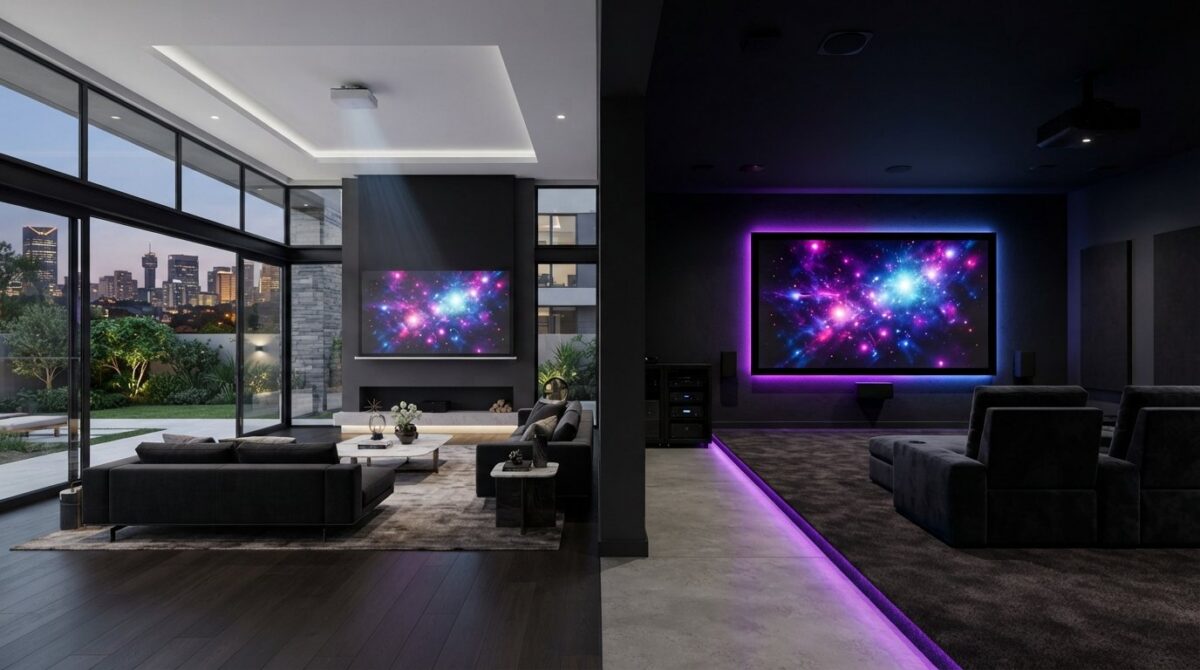
A projector screen is not passive fabric; it functions as an optical engine that dictates half of your entire picture performance. Projecting a cutting-edge 4K image onto a plain white wall throws away half the contrast you paid for. If you find yourself asking which projector screen fabric and frame style will deliver the best picture in your specific room, you need an exact framework. Learning how to choose a projector screen properly ensures your multi-purpose living area or dedicated cinema room achieves true visual brilliance without washed-out colours.
You probably already know the frustration of battling ambient daylight, where an uncontrolled ray of sunshine reduces deep blacks to a muddy grey. It is just as easy to feel overwhelmed by technical jargon like gain, micro-perforations, and angular reflection, or torn between a sleek velvet fixed frame and a discreet motorised drop-down casing. Discover how to choose the ideal projector screen material, gain, and mechanism to achieve stunning home cinema visuals with absolute confidence. This guide breaks down ambient light rejection physics, throw ratios, and sizing standards to help you create your dream cinema setup.
Key Takeaways
- Screen fabrics act as precision optical surfaces; learn why specialised ambient light rejection outperforms standard painted walls in brightly lit living areas.
- Master how to choose a projector screen with the correct optical gain to balance vivid brightness against wide, comfortable viewing angles.
- Evaluate fixed-frame versus motorised retractable mechanisms to balance permanent structural tension against multi-purpose room aesthetics.
- Calculate your ideal screen dimensions and aspect ratio using verified cinema viewing angles and projector throw ratios.
- Discover how acoustically transparent materials let you conceal speakers directly behind the display for authentic cinema soundstage alignment.
Screen Fabric and Ambient Light Rejection: Matching Room Lighting
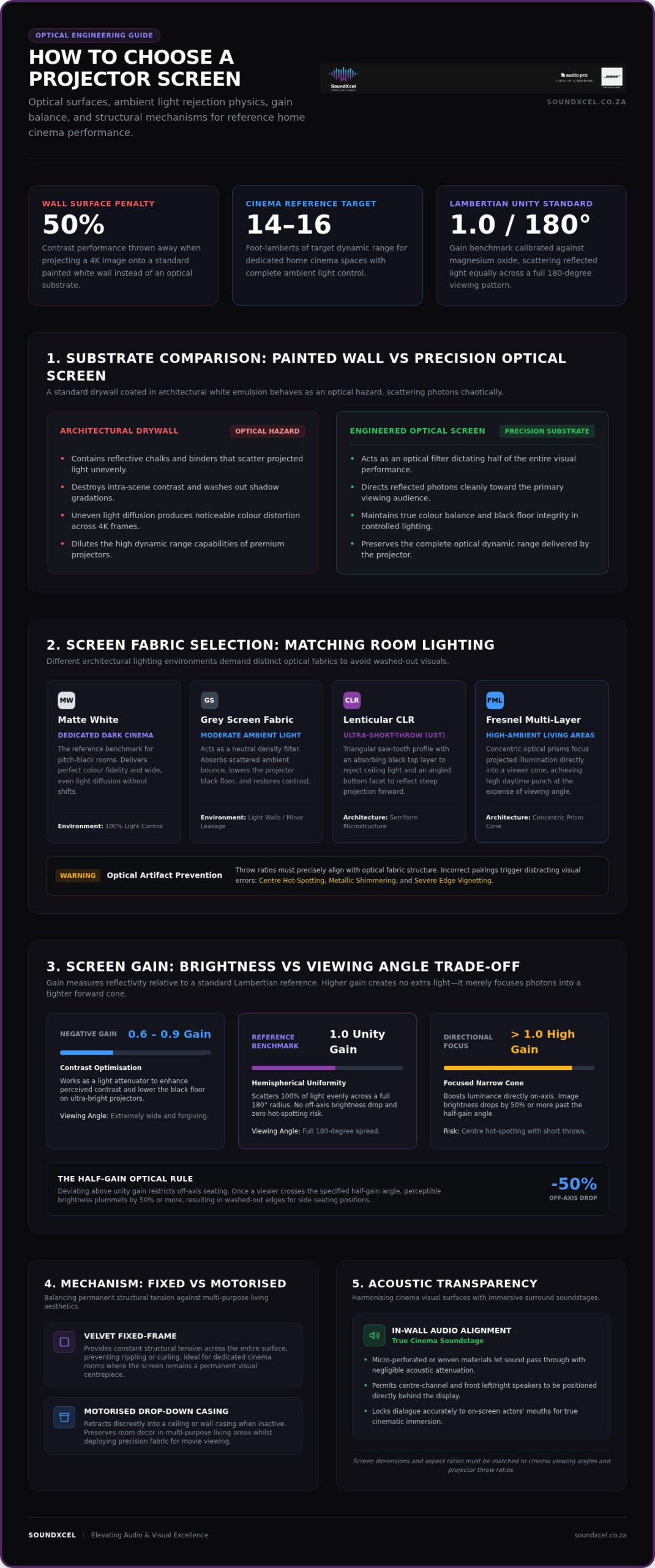
A standard drywall coated in white emulsion is an optical nightmare. Architectural wall paint contains reflective chalks and binders that scatter light chaotically, creating uneven diffusion and destroying colour accuracy. Projected beams require a micro-engineered substrate designed to reflect photons directly back to your eyes. High-performance units, including Epson home cinema projectors, produce incredible dynamic range, yet their luminance output means nothing if the surface dilutes intra-scene contrast. Learning how to choose a projector screen starts with treating the display surface as an optical filter rather than a blank canvas.
Your room lighting dictates your fabric choice. Dedicated cinema rooms with total light control allow you to target reference standard dynamic range levels of 14 to 16 foot-lamberts. Open-plan living spaces with side windows and white ceilings present a severe challenge. Stray photons hit the screen surface and wash out shadow detail. Ambient Light Rejecting (ALR) screens prevent this by deploying microscopic optical layers that absorb off-axis illumination whilst reflecting focused projector light toward the seating area.
To see how different materials perform across real-world lighting environments, watch this detailed comparison:
Matte White vs Grey Screens: Balancing Black Levels and Luminance
Matte white surfaces offer perfect colour fidelity and wide diffusion, making them the classic benchmark for pitch-black rooms. However, grey screen fabrics act as neutral density filters. They absorb scattered ambient reflections and lower the projector’s black floor. In spaces with light-coloured walls or minor daylight leakage, grey surfaces restore perceived contrast without compromising colour balance.
Ambient Light Rejecting (ALR) and Ceiling Light Rejecting (CLR) Technologies
True ALR materials use microscopic lenticular ridges or multi-layer optical coatings to filter out environmental glare. For ultra-short-throw (UST) projectors, standard ALR fails completely because the steep projection angle requires a specialized Ceiling Light Rejecting (CLR) serriform microstructure:
- Lenticular CLR structures: Feature a microscopic triangular saw-tooth profile with a black, light-absorbing top layer and an angled, reflective bottom facet to redirect steep upward projection forward.
- Fresnel multi-layer lenses: Direct light in a focused cone using concentric prisms, offering superb daytime punch in living rooms at the expense of a narrower viewing angle.
- Artifact prevention: Matching projector throw ratio to optical fabric prevents distracting optical flaws like centre hot-spotting, metallic shimmering, and severe edge vignetting.
Understanding these distinct physical architectures is essential when evaluating how to choose a projector screen for your specific lifestyle space.
Understanding Screen Gain: What It Means for Brightness and Viewing Angles
Screen gain measures reflectivity compared to a standard block of magnesium oxide or a classic Lambertian white surface. A screen rated at 1.0 gain reflects all incoming light evenly across a complete 180-degree hemispherical viewing pattern. Deviating from unity fundamentally alters how light behaves inside your room. Calculating this optical balance is a decisive step when mastering how to choose a projector screen, because physics demands a strict trade-off between perceived brightness and viewing angles.
Higher gain fabrics do not create additional photons. They simply focus the reflected beam forward into a narrower cone directly in front of the display. Step outside that sweet spot, and image brightness plummets by 50 percent or more once you cross the half-gain angle. Push gain too high with a short throw distance, and you risk severe hot-spotting; the centre of the image glows brightly while the outer edges visibly dim.
Low Gain (0.6 to 0.9): Enhancing Contrast in Bright Projectors
Negative gain fabrics work brilliantly with modern, high-output projection engines. High-lumen solid-state laser units often overpower dedicated dark rooms, lifting the black floor into murky dark grey. A grey 0.8 gain screen absorbs stray environmental bounce and pulls the black floor back down into rich, inky territory.
- Uniform dispersion: Lower gain materials naturally deliver broader horizontal viewing cones up to 160 degrees, keeping saturation consistent across wide corner sofas.
- Speckle suppression: The matte texture effectively smooths out laser speckle artefacts found in tri-laser optical engines.
- Dynamic balance: Absorbs secondary reflections bouncing off light-coloured side walls in mixed-use spaces.
Unity Gain (1.0) to High Gain (1.3+): Maximising Visual Punch
Unity 1.0 gain remains the reference baseline for pitch-black cinema rooms. It preserves exact colour temperature without skewing colour grading, distributing light equally across every seat in the house. By contrast, high gain materials (1.3 and above) focus light aggressively forward. They give life to low-lumen vintage lamps, illuminate massive 150-inch surfaces, or battle daylight in living areas.
Ensure your seating layout falls squarely inside the narrower cone before choosing a high gain fabric. Pairing the right optical surface with high-performance hardware, such as Epson home cinema projectors, ensures you achieve vivid HDR specular highlights without sacrificing off-axis colour consistency. Balancing screen gain with your projector’s raw ANSI lumens ensures you avoid harsh optical hot-spots whilst locking in stunning cinematic depth.
Fixed Frame vs Motorised Screens: Choosing the Ideal Mechanism
Your room architecture dictates the mounting format just as strictly as ambient lighting shapes fabric selection. Deciding between a static wall frame and an electric drop-down unit transforms how the room functions day-to-day. As you explore how to choose a projector screen, assess whether your space is a dedicated cinema sanctuary or a multi-functional lounge that must conceal entertainment gear when family or guests arrive.
Optical flatness is paramount. Modern high-resolution projection reveals even microscopic ripples in the fabric. This requirement becomes ultra-critical with ultra-short-throw (UST) projectors, which project light upwards at extremely steep angles (often throw ratios below 0.25:1). A tiny surface wave that passes unnoticed on a standard long-throw projector causes jarring, wavy image distortion under steep UST illumination. Non-tensioned drop-down screens will ruin that crisp 4K presentation.
Fixed Frame Screens: The Reference Home Cinema Benchmark
Fixed-frame designs remain the undisputed gold standard for pure visual performance. High-tension springs pull the fabric taut across a rigid aluminium chassis, locking the surface flat indefinitely. The wide bevelled borders, wrapped in light-absorbing black velvet, soak up slight projector overscan, delivering razor-sharp perceived image edges. With no motors, belts, or control boards to service, a fixed frame offers decades of zero-maintenance viewing.
Motorised and Concealed Systems: Elegance for Multi-Use Spaces
Motorised retractable mechanisms preserve your home aesthetic when a permanent massive frame does not suit your interior décor. Choosing an electric system requires paying attention to mechanical structural integrity:
- Lateral tab-tensioning: Robust nylon cords run through reinforced side tabs, counteracting the natural inward curl (“smile”) typical of standard drop-down vinyl.
- In-ceiling recessed housings: Flush trapdoors fit neatly inside ceiling bulkheads, descending via 12V projector triggers only when movie playback begins.
- Floor-rising scissor mechanics: Heavy-duty motorised scissor arms rise gracefully behind low-profile media credenzas, eliminating complex wall or ceiling structural work altogether.
When selecting a motorised assembly for ultra-short-throw projectors, insist on tab-tensioned or rigid floor-rising architectures. A smooth, trampoline-flat surface is mandatory to preserve optical geometry across every square centimetre. Knowing how to choose a projector screen mechanism correctly ensures you protect your interior styling without compromising reference-level image stability.
Screen Sizing, Aspect Ratios, and Throw Distance Calculation
Selecting display dimensions requires balancing immersion with human visual comfort. If you sit too close to a massive surface, rapid panning causes eye strain; sit too far, and cinematic impact disappears. SMPTE standard ST 2095 recommends a 30-degree horizontal field of view for mixed media, while THX home cinema guidelines establish 36 degrees as an acceptable minimum and 40 degrees for peak immersion. To calculate a 40-degree field of view quickly, multiply your screen diagonal in inches by 0.835 to establish your ideal seating distance. Learning how to choose a projector screen properly requires matching these geometric baselines to your room layout.
Your hardware optics must support this visual cone. Establish your physical boundaries using the universal formula: throw distance equals screen width multiplied by projector throw ratio. A standard-throw unit with a 1.4:1 ratio projecting onto a 2.5-metre wide image demands at least 3.5 metres of optical clearance between the front glass element and the fabric.
Aspect Ratio Dilemma: 16:9 Widescreen vs 2.35:1 Cinemascope
Content habits dictate your ideal screen shape:
- 16:9 (1.78:1) Aspect Ratio: Matches modern broadcast television, console gaming, and streaming series perfectly without masking borders or black bars.
- 2.35:1 to 2.40:1 Cinemascope: Matches theatrical Hollywood releases, which account for roughly 70 to 80 percent of major feature films.
- Aspect masking and lens memory: Installing motorized horizontal masking or using lens memory presets preserves constant image height without grey letterbox bars above and below widescreen scenes.
Calculating Distance and Viewing Height for Maximum Comfort
Vertical sightlines matter just as much as width. CEDIA and SMPTE standards dictate that viewer eye level should not exceed a 15-degree upward tilt to the centre or top third of the fabric. Hanging a display too high forces unnatural neck extension that causes fatigue within an hour. Ideally, position the lower third of the viewing surface roughly parallel with seated eye level.
Always verify optical flexibility before drilling mounting brackets. Integrating an Epson projector with expansive horizontal and vertical lens shift simplifies placement, allowing exact image alignment without destructive digital keystone correction. For personalised engineering advice on room calculations, consult with our cinema installation specialists today. Navigating these spatial variables ensures you understand how to choose a projector screen size that guarantees long-term viewing luxury.
Acoustic Transparency: Integrating Cinema Visuals with Surround Sound
Grand visual scale falls flat if sound staging feels disconnected from on-screen action. Position a dedicated centre speaker beneath a massive 130-inch display, and dialogue seems to emanate from the carpet rather than the actor’s lips. This acoustic disconnect shatters immersion. Solving this sensory misalignment is a crucial consideration when deciding how to choose a projector screen. Acoustically transparent (AT) surfaces allow sound waves to pass directly through the screen material, locking spoken audio to the visual action.
Behind-screen placement unifies your front soundstage. Positioning your left, centre, and right speakers along an identical horizontal plane creates seamless acoustic panning as objects travel across the frame. To prevent comb filtering and fabric vibration, CEDIA guidelines recommend spacing speaker grilles at least 20 to 30 centimetres behind the screen plane.
Perforated Vinyl vs Woven Fabric: Visual and Audio Trade-offs
Acoustic transparency relies on two competing manufacturing approaches, each presenting unique engineering characteristics:
- Micro-perforated vinyl: Uses thousands of microscopic holes (roughly 0.5 mm in diameter) punched across the surface. While retaining strong gain, perforated vinyl causes high-frequency attenuation of 3.0 dB to 6.0 dB, demanding active treble compensation. Viewers must also sit at least 3 metres away to avoid seeing the physical hole pattern.
- Tightly woven fabrics: Interlaced fibres allow sound to slip naturally through microscopic gaps with negligible insertion loss (under 2.0 dB across critical treble ranges). This eliminates comb filtering on vocal tracks.
- Moiré elimination: Coarse perforations can align poorly with dense 4K pixel grids, creating shimmering moiré interference fringes. High-density woven fabrics eliminate this visual distortion entirely.
- Black scrim backings: Adding an acoustically transparent black rear layer prevents projector backlight from reflecting off shiny metallic speaker cones behind the display.
Building a Cohesive Audio-Visual System Across South Africa
True luxury home cinema merges reference visuals with spatial sound. Pairing high-output projection with a premium bose sound system provides breathtaking dynamic headroom. For multi-channel surround calibration and screen placement strategies, explore our comprehensive Bose Lifestyle and Epson projector setup guide. Mastering how to choose a projector screen with acoustic transparency ensures you enjoy reference visual detail without compromising acoustic realism.
Elevate Your Home Cinema Experience
Selecting your display surface represents an essential optical decision rather than a cosmetic afterthought. Pairing ambient light rejecting fabrics with your room’s natural daylight, dialing in screen gain, and ensuring flat mechanical tension unlock the complete dynamic range of your projection system. When you integrate acoustically transparent woven fabrics, sound and imagery converge to produce authentic theatrical immersion.
Understanding how to choose a projector screen turns a collection of separate components into an interconnected home cinema. As an authorised national retailer of high-performance Epson home cinema projectors and premium Bose audio systems, SoundXcel delivers specialist integration expertise to residential spaces across South Africa. Bring your room dimensions to our team to engineer a tailored system combining reference visuals with spatial clarity. Explore premium projectors and audio solutions to transform your home entertainment today.
Frequently Asked Questions
Can I simply project onto a smooth white wall instead of buying a screen?
No, projecting onto standard drywall degrades colour fidelity and destroys dynamic contrast. Architectural wall paint scatters light erratically due to uneven chalks and binders. Even smooth drywall possesses micro-textures that introduce optical grain and soften 4K focus. Specialised screen fabrics feature microscopic optical coatings engineered to reflect focused light uniformly back to your eyes, preserving black levels that walls simply wash away.
What is ambient light rejection (ALR), and do I really need it in my living room?
Ambient light rejection uses microscopic optical layers to absorb off-axis ambient light while selectively reflecting the projector’s direct beam. You definitely need an ALR screen if your projector operates in a multi-purpose living space with windows or pale ceilings. Without ALR technology, uncontrolled room light reflects off the display surface, turning deep shadows into dull grey. It preserves rich contrast without requiring a pitch-black room.
How do I determine the best screen gain for my home cinema projector?
Match screen gain to your projector’s lumen output, room darkness, and seating arrangement. When evaluating how to choose a projector screen, pair high-output laser projectors with low gain (0.6 to 0.9) to deepen black floors and widen viewing angles. Choose unity 1.0 gain for light-controlled, dedicated rooms with standard-throw units. Reserve higher gain (1.3+) for expansive displays or lower-powered lamps, keeping in mind that off-centre seats will experience dimmer images.
What is the difference between woven and micro-perforated acoustically transparent screens?
Woven fabrics let sound pass through interlaced fibres, whereas micro-perforated vinyl relies on thousands of tiny punched holes. Woven fabrics introduce negligible high-frequency loss (under 2 dB) and eliminate moiré patterns with 4K projectors, making them ideal for close seating. Micro-perforated vinyl delivers slightly higher optical gain but attenuates treble by 3 to 6 dB, requiring active equalisation and a seating distance beyond 3 metres to hide the holes.
Is a 16:9 or 2.35:1 aspect ratio better for a multi-purpose home cinema?
A 16:9 aspect ratio is better for multi-purpose spaces that host television shows, sports, and gaming alongside movies. Modern series and consoles output natively in 16:9, filling the entire canvas cleanly. If your room serves primarily as a dedicated theatrical screening room showing cinematic films, 2.35:1 Cinemascope delivers true theatrical scale. For mixed usage without horizontal black bars on standard media, 16:9 remains the most versatile format.
Why is tab-tensioning necessary on motorised electric projector screens?
Tab-tensioning uses lateral cords to pull the screen flat, preventing the edges from curling inward over time. Standard retractable vinyl inevitably curls at the borders, creating ripples across the image. Optical geometry demands absolute flatness, especially when using ultra-short-throw projectors where steep projection angles turn minute surface waves into severe distortions. Tab-tensioned systems replicate the rigidity of a fixed frame whilst preserving the ability to conceal the screen inside your ceiling.
How far should I sit from a 120-inch projector screen for optimal viewing comfort?
Sit approximately 3.6 to 4.0 metres away from a 120-inch 16:9 screen for reference cinematic immersion. This distance aligns with THX recommendations for a 36 to 40-degree field of view. It allows full peripheral immersion without requiring continuous head turning during fast-moving scenes. Factoring in viewing distance alongside room dimensions is a vital step in learning how to choose a projector screen that provides maximum comfort and cinematic scale.
